

The fruit and fatigue of a 100-day publishing challenge
obvious benefits and lingering questions

On a whim, I decided to publish something new every day in Q2. I later extended this to a 100-day challenge, as it sounded cooler.
Well, not entirely on a whim. There was some building pressure: I’m an over-thinker who loves ideas, but gets tangled up in them and then struggles to share consistently. I had also just finished reading some Francis Keller, who reflected that the pieces of ourselves we hide, we experience as a kind of loss. This resonated, and I wanted a blank canvas to write about anything and everything that interested me, without censoring for particular audiences.
I’ve been rebuilding my writing since my life went into meltdown. Writing was part of what pulled me out of that hole. And this year, I felt curious about publishing more and seeing what would emerge if I didn’t prescribe any outcomes.
The Challenge
I did what I set out to do: I published for 100 days straight. You can view all the posts here, from Apr 1 to July 10.
I learned a lot:
I starved my perfectionism of its oxygen
I raided my bag of treasures
I reduced and clarified my thinking
I got a better handle on my taste
I became a ruthless editor
I got more confident providing value at velocity
I was better able to retain and articulate ideas
But it wasn’t all peachy:
Shorter pieces enforce a nauseating style of writing
I wish I’d free-written more
I used AI, but not much
Publishing in silence is hard
Writing is still writing
I usually wrote first thing on a laptop, in Obsidian. Sometimes I’d write from scratch; other times I’d have a fragment I wanted to expand upon. Six of the days were handwritten in a Moleskine journal while on a meditation retreat and transcribed when I got home.
I always wrote in blocks—25-minute, focused sessions. On a good day, I’d write a draft in one block, and edit and publish in the next one, with change to spare. I would then paste everything into Grammarly, accept some changes, and move the finished copy into a Markdown file for Hugo to turn into a new page. I did this all on my personal website, for reasons I outlined here.
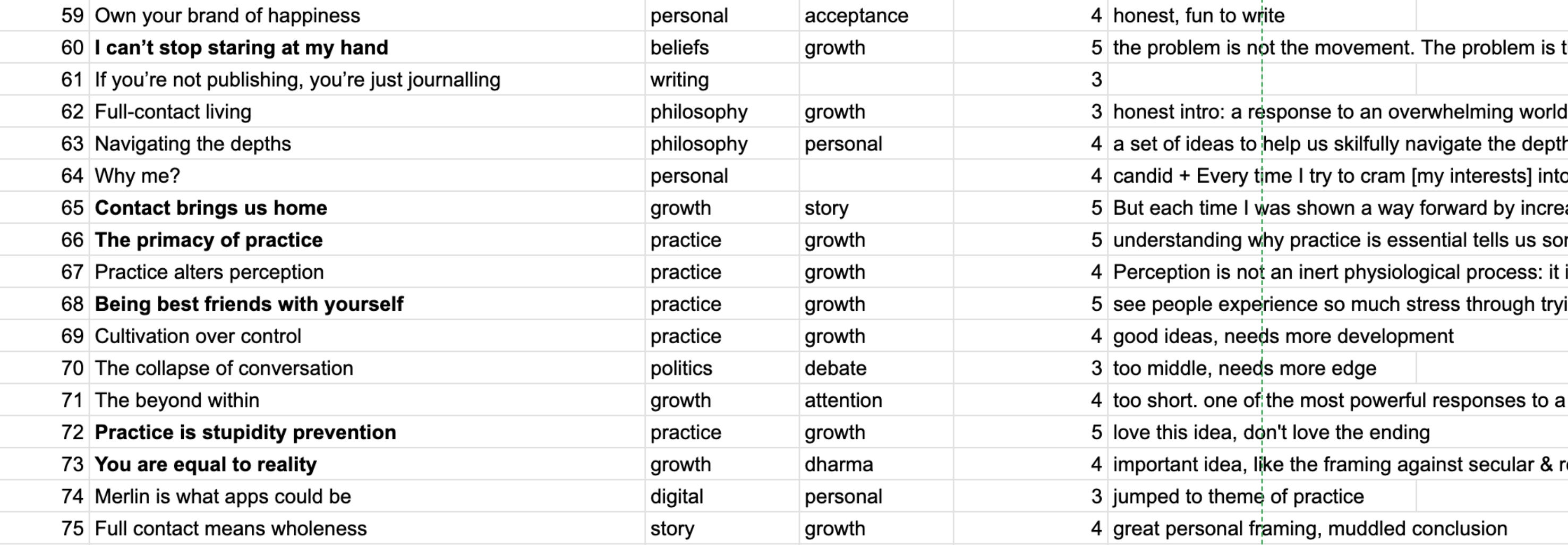
Some days were a joy, some days were like pulling teeth. Towards the end, fatigue set in and I fell behind, but caught up. After the challenge finished, I opened a spreadsheet whilst I re-read each piece. I added tags, left comments and rated it out of 5. You can see that spreadsheet here if you’re interested.
The obvious benefits
I starved my perfectionism of oxygen
I published more high-quality writings than I expected. But, perhaps more importantly, I published some sub-standard posts without the world imploding.
Publishing each day means experiencing the pain of never being able to say anything completely. Or rather, trading that off for saying something.
I highly recommend this for over-thinkers and perfectionists.
Your perfectionism won’t suddenly disappear. You don’t need to dismantle it—this is just another flavour of perfectionism. What happens is that you create a parallel space in which you do ship things and they’re not perfect, and everything is okay and often better than ok.
You start to pay more attention to that space, and the more attention you pay to it, the more you come to inhabit it. You realise that this is the real world, and that you were living somewhere else.
I raided my bag of treasures
Having to write every day means that you have to raid your bag of ideas, your precious ideas that you were saving for the perfect time or the ideal level of inspiration.
When you start emptying the bag, sometimes a spark will begin glowing inside of you. Other times, your ideas will clatter as they hit the ground, echoing in the hallway of unmet expectations.
The good news is that it’s a net positive either way. You bring the treasure into the light of day, or realise it was no treasure to begin with. Some of the things I’ve published are things I’ve been thinking about for ten years. And now some small version of them is out there. That feels wonderful.
I reduced and clarified my thinking
You can write and edit ‘til the cows come home, but there is something unique to hitting the publish button that is impossible to recreate. As I wrote on Day 7:
…things clarify rapidly when your finger is hovering over the publish button. That haggard paragraph that survived 3 drafts meets its end. The witty tangent that you couldn’t let go of seems like a painful distraction.
All the superfluous cruft that you’d been holding on to evaporates before the impending eyes of other human beings. Publishing each day raises this clarifying process to a fever pitch.
I got a better handle on my taste
I recommend that you think of a challenge as a way of refining your taste, rather than delivering a particular outcome. Your taste is what you value the most, and which ideas most frequently draw you into their orbit. Each published piece is a chord in the larger symphony of your taste.
This won’t be easy if you have a lot of interests. I had an intuitive sense of my taste, but by dipping into so many of the topics that interest me and repeatedly publishing whatever I felt like, I was able to see:
What I’m drawn to the most
The patterns in the pieces I’m proudest of
Which pieces sounded natural and engaging, and which sounded stuffy and abstract
Knowing your taste and what you value is the primary fuel for everything worthwhile you want to do in life.
Here were the most common topics I wrote about:
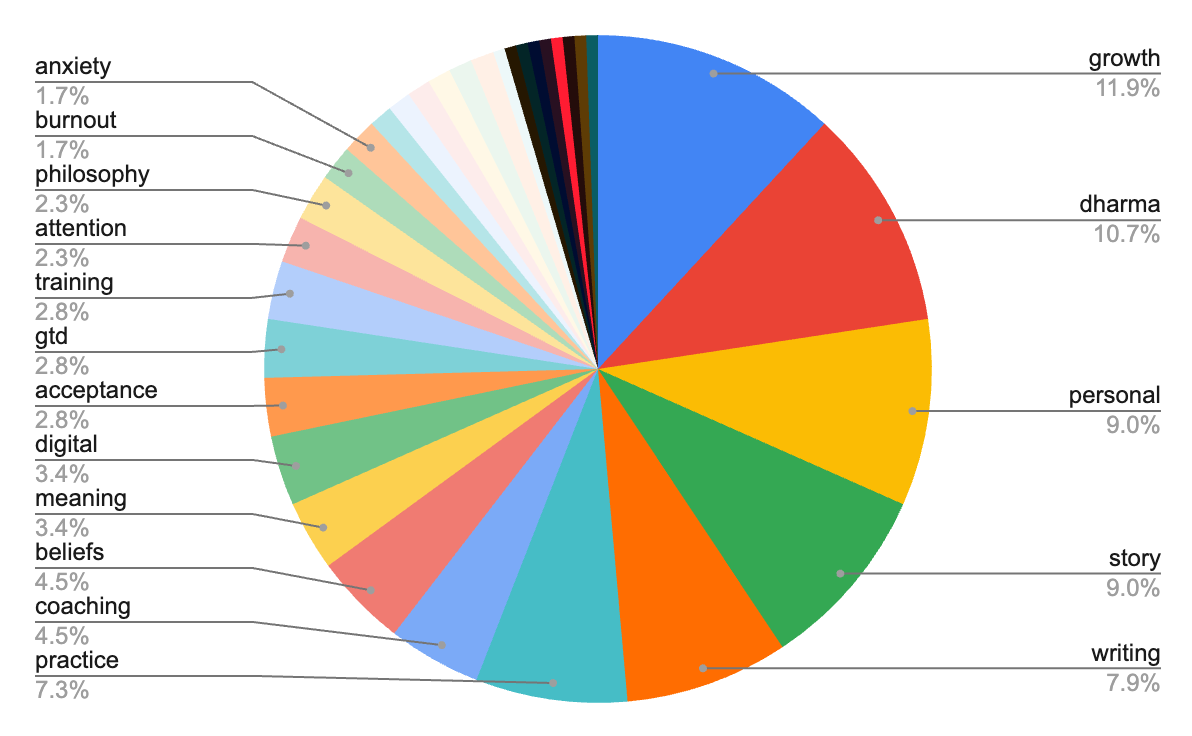
In short, I wrote a lot about growth, with a spiritual edging (dharma), including plenty of personal stories and reflections on the practice of writing itself.
I became a ruthless editor
Like any good procrastinator, I’ve always enjoyed editing. But I still hung on to flaky ideas or smart-ass sentences, in the hope that they’d suddenly elevate the piece to new heights.
Publishing each day simply left no time for that. I had no time to let things linger. So I cut a lot more. Because the pieces were small and I could publish again tomorrow, this felt easier.
I became much better at distinguishing one idea from two or three. Oftentimes, I’d think I was communicating one thing, but then I’d introduce a new metaphor or perspective that would muddy the waters. After a few weeks, this became very obvious. I could feel the pull, the awkwardness of trying to follow two tracks. Sometimes, I would allow two ideas to remain—time be damned—but on reflection I’d always feel that the piece was weaker for it.
Closely related to the editing, I was also repurposing. One of the hardest parts of the challenge was that it was more than just daily publishing. Every Wednesday and Friday, I was also sending out newsletters! One was a summary of my daily writings, and one was targeted to a more technical audience.
Even that wasn’t everything. As I was publishing so much, I thought I should share some of it on social media. So I rejoined several social networks. Repurposing the writings and pulling out the most salient themes got me even more ruthless about editing.
I got more confident in providing value at velocity
Confidence was never my primary issue beforehand. But being able to take an idea and publish something interesting on it within 30-60 minutes was confidence-building.
I’m proud of 75% of the pieces. They read well, and I think they have something important to say. I also had people reaching out to tell me they liked what I was doing, had a few discovery calls from people reading these daily musings, and picked up new founding members of this Substack.
As another benchmark, Derek Sivers spent 3-6 hours per post in his 30-day challenge. There’s no wrong or right answer to how long you should spend, but by the end of it, I certainly felt more confident in being able to provide value at velocity.
I was better able to retain and articulate ideas
I predicted:
…thinking and learning improvements beyond the actual content I’m writing about. Rapidly moving from private ideas to public articles trains your articulation and communication; qualities that lie upstream of any one idea.
This held up.
I learned a lot very quickly through acting each day. Each day, ideas were clarified and fed into the next post. I did a lot of networking and a couple of interviews during this time, and many of the insights felt easy to articulate and share. I was also better at translating fresh ideas into other projects I was working on, like launching The Tech Coach.
Other lessons
Shorter pieces enforce a nauseating style of writing
Having to publish each day meant leaning into a short, pithy style that I didn’t always like. It’s a popular writing style—a fatigued contrarianism, or a story sandwiched between a hook and a hot take. See Seth Godin, the entirety of LinkedIn, etc.
Most worthwhile ideas resist this level of compression, and I care a lot about those ideas. But when you have to publish each day, it’s hard to avoid it.
I wish I’d free-written more
The pieces I wrote from scratch were the best ones.
One benefit of a note-taking addiction is that you have plenty of ideas to work with. Quite often, I’d pull a note with some scattered reflections and write that out. But it was always more forced than freewriting:
Instead of just writing, I’m trying to prop up existing statements. It’s like starting with 4 or 5 islands and then slowly building bridges between them.
It’s brittle. Because I’ve given the statements more solidity than they’re worth. I’ve sacrificed how I might say something now in favour of justifying how I said it then.
It feels more comfortable. There’s lots of incremental re-arranging because the notes usually have no narrative flow. It’s obvious now that this is a momentum killer. It’s jumping straight into editing, instead of writing.
Free writing starts with a blank page and involves a higher pace. It’s not easy, but it’s very satisfying and the results are often better.
I wish I’d done more of it. If I were to do the challenge again, I would make this a rule: always start with a blank page.
I used AI, but not much
Did I use AI? Not much. I’d say 80% of the posts had zero AI input.
I used it mostly for idea generation, riffs on a topic, and for helping me end pieces more definitively—I struggle with tying off shorter pieces. For example, it gave me the hinge metaphor for one piece, which I thought worked well. I occasionally used it as an editor when my piece felt too meandering, and asked it to explain why it suggested changes it did. I would copy over a few sentences if they read well.
Publishing in silence is hard
Working in silence and shipping each day to crickets is a lonely business. I did this on my personal website, so no one was getting emailed. I did summarise my posts each week on this Substack and got some great feedback from that.
But most days, you publish and don’t hear anything back. This was liberating at first, but tiring as the days ticked by.
Writing is still writing
I fell into some illusion that in producing and sharing a certain volume of thoughts, something magic would click, and I’d be in a different place with my writings. Like, finally, the groundwork would be laid, and the rest would be more accomplished and less chaotic. If that sounds awesome, I have bad news for you.
Instead, I just published a lot. I now have more writings out there. Some of them are quite good. There were some interesting emergent trends, but I still sit down with the same fears and internal battles as when I started the challenge.
Now I just have better-honed skills and more confidence in the process than I did before.
Highlights
In case you didn’t show up every morning at my website, here are my 10 favourite pieces:
I was also happy with the personal stories I shared along the way, which were a mix of butt-clenchingly painful and revelatory. You can read them all here. If you want one to start with, try Meeting Mr Cool.